
Set Up Project Templates
Applies to: All Maxio modules
Last updated on Oct 13, 2026
Project Templates are used during the initial creation of a Project as the "base model" upon which a new Project is built.
View Project Templates
Go to Projects, then click Templates to open the Project Templates page. The page displays a list of all existing Templates in your account; click the name of an existing Template to modify or delete it.

Please be aware that this article is related to Maxio Platform's Projects functionality. Projects in Maxio Platform allow you to gradually build out Contracts for any Sales Orders that have been booked with incomplete or yet-to-be-determined elements.
Create a Template
You can create as many Templates as are needed, each with its own Milestones and Triggered Actions.
To create a Project Template
- From the Project Templates page, select Add Project Template.
- Enter a Name for the Template and click Save.
- On the Template's detail view, select Add Milestone to add each Milestone the Template needs, along with its Triggered Actions.
Milestones and Triggered Actions
A Milestone is an event-driven marker that triggers a set of specified actions (Triggered Actions) at a specified point in time (Trigger Dates), letting you create and update Invoices, Revenue Entries, and Transaction information for Contracts with yet-to-be-determined elements. As new details of a Contract are unveiled or key Contract-related events take place, mark the corresponding Milestones complete to "fire" their Triggered Actions.
The individual Template view displays all the Milestones contained within the Template, and lets you select Save As... to clone the Template under a new name. When Milestones are added to, edited, or deleted from a Template, Projects that have already been created are not affected by these changes. Likewise, modifying the Milestones on an individual Project doesn't affect the Template it was created from. Each Project's Milestones are its own once the Project exists.
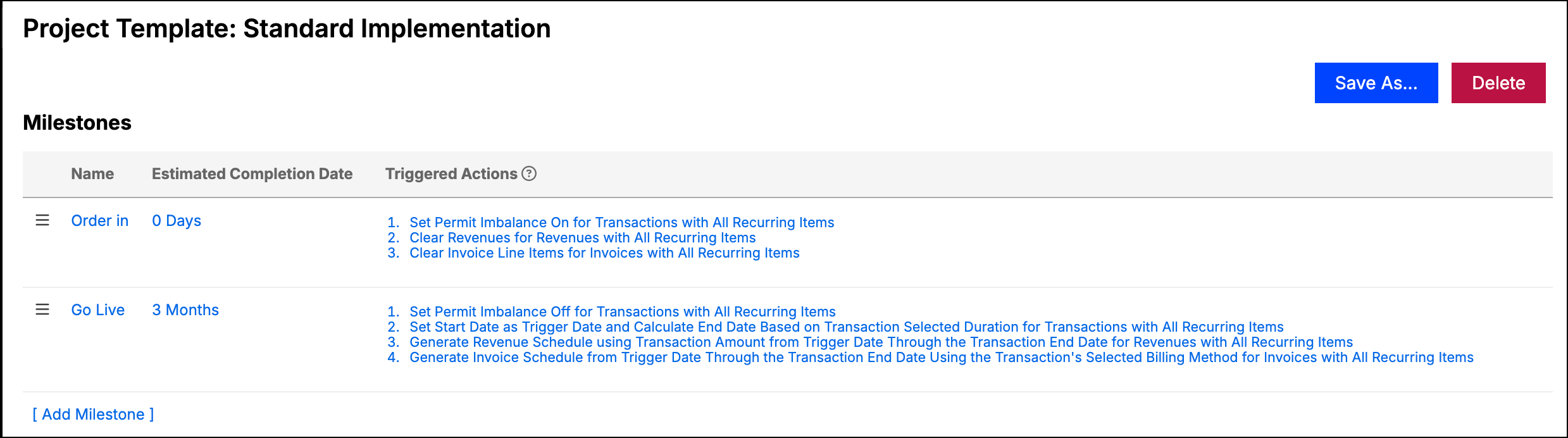
Add Milestone
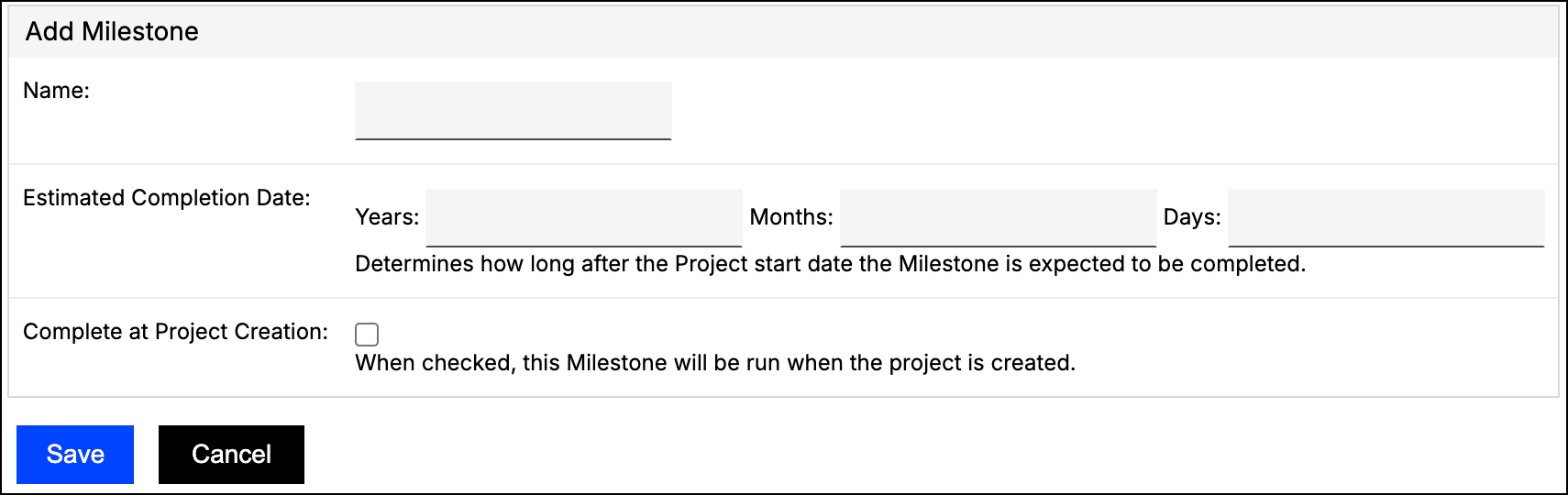
Add a Milestone to define an event that fires one or more Triggered Actions.
| Field | Description |
|---|---|
| Name | The name of the Milestone being created, which typically correlates with a real-life event.
|
| Estimated Completion Date | Enter an offset, in Years, Months, and/or Days, after the Project Start Date. This determines how long after the Project Start Date the Milestone is due to be completed. The Due Date appears as a reminder in the Projects List and the Project view. When a Due Date has passed, a warning icon appears next to that Project in the Projects List. If left blank, the Milestone is considered due on the same day as the Project Start Date. |
| Complete at Project Creation | Check this box for the Milestone to be automatically marked as complete upon Project creation, which fires the Triggered Actions when you save the Project. This feature is often used for an "Order In" or "Contract Signed" Milestone. |
Triggered Actions
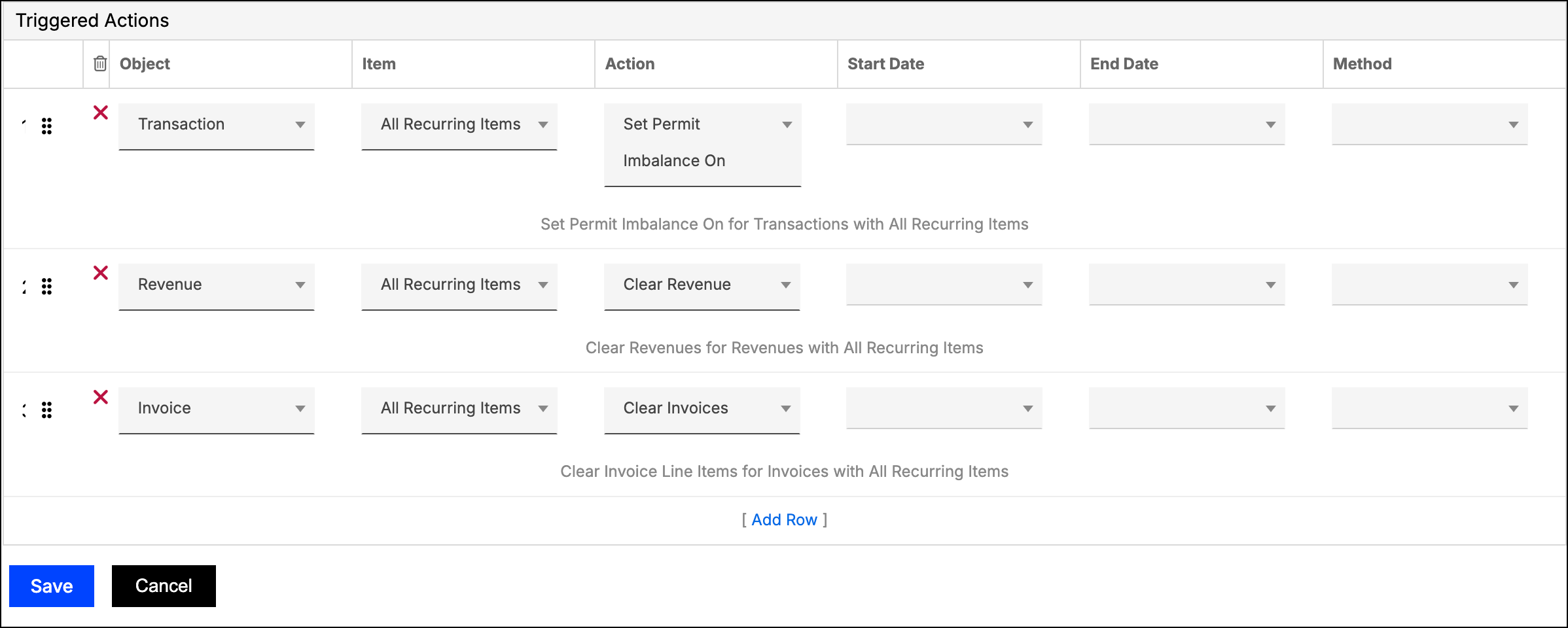
A Milestone's Triggered Actions fire in the order shown; drag and drop to reorder them.
| Column | Description |
|---|---|
| Object | Select a type of financial record to perform a specific action upon.
|
| Item | Choose an Item or category of Items to which the Triggered Action applies. Any Transactions in the Project that use this Item are subject to the Triggered Action upon the completion of the Milestone.
|
| Action | Choose which Action to perform on the selected Object when the Milestone is marked complete. If your selected Action requires a percentage, amount, Start Date, End Date, or Method to be specified, enter an input for those fields before you can save the Milestone. |
Download, import, and replace templates from a file
You can download a Template as a CSV file, edit it in a spreadsheet, and use that file to create a new Template or to replace an existing Template's Milestones and Triggered Actions. This is useful for moving a Template's configuration to another site, or changing several Milestones and Triggered Actions at once instead of one at a time in the Template editor. To copy a Template on the same site, use Save As... instead. Downloading, importing, and replacing a Template all require the Editor role.
Download a template
From a Template's detail view, select Download Project Template, then select Export All Columns - Download to download the Template as a CSV file, or Export All Columns - Google Sheets to export it straight to a Google Sheet. See Export and Download Data for how a large download runs in the background.
The file holds one row per Triggered Action, grouped into Milestones by the Milestone # column; a Milestone with no Triggered Actions appears as a single row with its Action columns blank. Items, Item Groups, Revenue Books, and Triggered Actions are written by name, so a file downloaded from one site imports cleanly into another site that has the same names set up.
Import a template from a file
The Project Templates page offers Import Project Template, which creates a new Template from a file downloaded from this site or another one.
To import a Template
- From the Project Templates page, select Import Project Template.
- Select the CSV file to upload.
- Optionally enter a Project Template Name. Leaving it blank uses the Project Template name stored in the file. If the file names more than one Template, or none, enter a name.
- Select Import.
The Import Project Template page also links to a downloadable example file and a downloadable list of valid values. The same Valid Values reference is shown on the page, listing the Actions, Item Types, Durations, and Complete at Project Creation entries the file accepts. The Action column accepts either an Action's key or its description, as long as the description belongs to only one Action.
Importing always creates a new Template rather than changing an existing one: if the Template name, whether entered or taken from the file, matches an existing Template, the import is rejected with a suggestion to enter a different name or use Replace from File instead. The file must be a CSV file saved with UTF-8 encoding, up to 5 MB and 10,000 rows of data. Items, Item Groups, and Revenue Books named in the file must already exist on this site under matching names. Items and Revenue Books must also be active, and Revenue Books can be used only when Advanced Revenue is enabled. If any row fails validation, nothing is saved, and the Import page lists every row's errors together so you can fix them at once.
Replace a template's Milestones from a file
A Template's detail view also offers Replace from File, for applying an edited file to that Template without creating a new one.
To replace a Template
- From the Template's detail view, select Replace from File.
- Select the CSV file to upload.
- Check Confirm Replacement.
- Select Replace.
The same file requirements and checks apply as for an import. If any row fails validation, the Template is not changed. Otherwise, replacing deletes every one of the Template's Milestones and Triggered Actions and replaces them with the ones in the file; the Project Template name stored in the file is ignored, since the file only replaces the content of the Template you selected. Existing Projects already created from this Template keep their own Milestones and Triggered Actions and are not affected by the replacement.
Delete a Template
Deleting a Project Template deletes all of its Milestones (and their associated due dates and Triggers). This action cannot be undone. Existing Projects created using the Template are not deleted or altered.
Related information
You can learn more about Projects in Understand Projects.
To filter Transactions by Project Template, see Track Projects and Transactions from the Landing Page.
Still need help?
Reach out and our support team will take it from here.